Sunday, June 28, 2009

Take A Second Look: Transformers, Revenge of The Fallen--Junk, Undeniable Thrilling Fun...and then Some

Photo Taken From:

Admit it: you like junk food, don't you? Don't deny it and stop fooling yourself. It's not as if you indulge your craving for them every day, much less every minute. Once in a while, however, junk food can be that one little inconsequential guilty pleasure which must be, well, consummated. Sure, they say it's bad for you. But hey, it's not exactly like shooting yourself in the head. There are simply some instances when giving in to certain reckless appetites can be the perfect tonic to the stiff routine of our lives. So go ahead, grab that bag of salty, calorie-laden potato chips and stuff them into your mouth. Have your fill of that supmtuous bar of chocolate or liter of ice cream. They say most doughnuts sold in diners make you fat--well so what? They're sweet, creamy, and they are best taken with harmful cola beverages. Go ahead and cram yourself!

And you know what the good part it? All the rubbish you can fill your time with does not have to end with food. You can waste an hour or two shooting badasses in a video game. If you have a car, you can drive to wherever feels fine and for all the world be the proverbial schmuck on four wheels. Sing along to the latest noisy song reverberating with the phat bass. Hell, throw all your inhibitions away and put on that porn flick on your movie player. Would that be pushing the envelope too much? Then watch Transformers: The Revenge of the Fallen on IMAX.

Photo Taken From:

Okay, one thing must be clear. The first live-action Transformers movie was pure junk. This second installment in the franchise isn't necessarily any spectacular improvement--even if it does deliver on a promise to show more outrageous destruction, knuckle-cracking mayhem, and action of such high-octane it approaches the rush of crystal meth. Yeah, nobody ought to look for any story or plot in a movie like this. It's pure nonsense to expect substance of any sort from this two-and-a-half hour extravaganza. No, this was meant for the voyeuristic junkie in all of us...the same sort of persons who tune in to the news on television every night just to watch rape victims cry their heart out at police stations, the drunks and street criminals being rounded up by the authorities, the car accidents, the people running helter-skelter from natural disasters. Story and meaning aren't important here. What's the sole simple reward is watching gigantic mechanical warriors engaging in mortal combat, maiming and dismembering each other for domination of the universe...or in this case, the earth for the meantime. The universe can wait until part 4 or part 6, perhaps.

There's always a rush in watching battle and conflict. In any case, you're rooting for the good guys. And of course you know they'll win.

Photo Taken From:

As was mentioned earlier, there's totally no use in arguing that this movie holds any deeper meaning than what it promised. You want to see robots fighting? You got it. There is over an hour's worth of robot-fighting here, rendered miraculously in crystal-clear computer-generated imagery that takes seeing to believe. It's like watching cars pummeling each other--an absolute glory! Metal bodies cartwheel and tumble at breakneck pace in martial-arts choreography, thanks to that wonderful invention called "motion capture". For generations of viewers who thought that such scenes could only be enjoyed in animation that would not be photo-realistic, this is a beatific experience that is just totally the meanest, slickest, and the sickest.

Photo Taken From:

It's the easiest thing in the world to be one of the naysayers and declare that "Revenge of the Fallen" is better left unwatched, since it imparts nothing worthwhile. Nah, that would be too narrow a perspective. There are many things viewers can take away after riding this roller-coaster, even if they don't directly have anything to do with the movie's "themes" or content--it's any attempt at enlarging upon such aspects of the film that's a perfect waste of time. Let us just stick to some other points that can be pondered:

1) It's a successful business venture

The people who made the film will surely earn a lot of money. It's a simple equation. In order to make such a gargantuan story come to life on the big screen, they had to spend around the territory of 150 million or more US Dollars. It could well have been a bigger amount.

Is that too unimaginable an amount of money to invest in any enterprise? An amount like that could buy anybody around 3 SM supermalls--maybe even 5. And they decide to make a movie? It might sound preposterous to some degree. However, there is a good chance that the movie itself might earn around 200 percent, or double the initial capital, in less than a month. 5 SM supermalls can't do that within the same time period. In other words, "Revenge of the Fallen" was a good business decision.

Of course the whole movie was simply made to take your money. That's not entirely objectionable. Barbie dolls also have the same objective. And for some people, Barbie dolls might even be more insiduously subversive to the impressionable minds of young girls. Then again, who are the parents to complain about any deep, underlying, undesirable psychological effects of Barbie? Oh, and by the way, the Transformers movie franchise itself is inextricable from the line of toys made by Hasbro, which incredibly puts the robots right into your own hands! Imagine that. Which means even more money for the "Transformers" brand.

Photo Taken From:

2) It's a better watching experience than seeing yet another squeaky clean boy and girl loveteam lip-locking onscreen

As of late, the only Pinoy films we can choose from, no matter how many they seem to be, are in the "romantic" genre, meaning they are about star-crossed lovers who cry every five minutes because of all sorts of circumstances keeping them apart, and then four minutes before the end a twist of fate brings them together. We keep seeing so much of them we can sleep through any one of them and imagine the story in our heads. When we wake up, the ending onscreen would be the same, in any case.

3) It can be watched on IMAX

Photo Taken From:

There's nothing like seeing the hell out of automatons in resplendent and near-photo-realistic CGI rendering tearing each other to bits--in a gigantic screen designed to overwhelm your eyes. There's buzz going around the internet which said the mega-modern computer that ILM special effects gurus used to create the Decepticon colossus Devastator actually melted during "rendering"--that is, the process by which the computer engine actually builds the visual rendition of Devastator pixel by pixel. Just imagine feasting your sights on a work of art so technically demanding and cutting-edge that it even reduced the most formidable gadgetry to fudge and taffy! In living 50-foot color--about five storeys high! That just about beats seeing Godzilla or any other pussyfooted dinosaur on standard screens. The experience is absolutely, wickedly mind-blowing. Never mind that you don't know what the heck it is anyway these monsters are troubling themselves with--if they dismember each other, the audience will ask for more. Not to mention--harharhar--the blast and reverb of digital surround sound bringing you right in the middle of those chest-pounding explosions and the ear-crackling throbs and hammerings of pure mayhem.

Transformers on IMAX will from now and forevermore be paradise on scorched earth.

4) You can probably play a video game of the movie later on in your personal computer or gaming console

Now, how can anybody ever do this with most other movies today? The record-holder for the highest grossing Pinoy movie ever shown in the Philippines as of the present is "Feng Shui", this horror gig starring the daughter of a former Pinoy President. And that's not a joke. Anyway, the movie is not supposed to be such a terrifying experience because of the fact that a Presidential daughter is part of the cast. In any case, a movie like "Feng Shui" won't ever have its own nifty video game. Absolutely nobody will be able to sit through "Feng Shui" for two hours or so and then expect that some time in the near future ( perhaps even the moment you get home ), you can sit down in front of your television or your computer, then relive its story through another three or four hours of gaming. But with "Transformers: Revenge of the Fallen", you certainly can! Isn't that a stroke of genius?

It's a win-win situation for everybody. The Transformers franchise earns more money because of the games they can merchandise, and gamers can return again and again into the Transformers Universe and keep on seeing robots blasting each other to smithereens--with you in it, or at least your robot character ( for goodness' sakes )--right up to the months and years it takes when another Transformers sequel comes along. "Feng Shui" can't do that to the viewers, and that just about explains why the top-grossing Pinoy film in the Philippines can't have a sequel. Less money for the producers. Harharhar...hmmmm. Maybe a video game with the computer generated image of a Presidential daughter wouldn't really sell that well.

Photo Taken From:

5) And speaking of sequels, yes, the Transformers movies are going to spawn even more sequels in the future

You'd think at first that the Transformers franchise of movies would end with three, or perhaps four, sequels. You'd think all the Decepticons would be wiped out by Part Four, maybe. Ever notice anything about this most recent Transformers movie? They never indicated whether it was the second part or whatever, numerically anyhow. Which only means one thing: you'd think Harry Potter or James Bond are the only movies that run on and on for seven or more parts? You honestly suppose that The Star Wars franchise or the Star Trek revivals are the only special effects extravaganzas that would have the clout to run on for more than five installments? Nah, the Transformers movies won't be another trilogy or six- or seven-part movie series.

It will go on and on...

There are just too many Decepticon asses to fry. There are simply too many Autobots still arriving to Earth. By the time anyone reading this reaches advanced senior age, he or she will realize that the revenge isn't anywhere near finished at all!

6) Finally, the innovative technology used to make the Transformers movies will benefit a whole lot of people, even those who didn't bother to watch.

Major advances in computer-generated imagery ( rendered in three dimensions with near photographic accuracy ) have mostly been continually improved by visual effects specialists engaged in filmmaking. From the machinations of engineers and technicians working assiduously in labs such as those found in Industrial Light and Magic ( ILM )--the wizards behind most of the eye-popping gimmickry we see on the silver screen--and Digital Domain, or even Weta, to mention a few, there often arise new software which push further the boundaries of the technology.

When once not long before it would be almost inconceivable to expect a movie to show us convincing images of gigantic automatons shooting and pummeling each other down to smithereens--viola! all of a sudden we are treated to Transformers movies. It's magic, undeniably, but magic that is borne of persistent scientific progress. Behind those scenes of Optimus Prime and Bumblebee and Megatron and Starscream hobnobbing with humans and human civilizations is handiwork that bespeaks thousands of man-hours of painstaking research. The real heroes aren't, after all, those transforming robots, but the people who themselves have begun transforming the landscape of what CGI animation can achieve. The implications of their achievements will not only be felt in future films, but will also bleed into other endeavours in which such know how is invaluable.

The area of medicine is gradually being enriched by newer and better CGI software that can vastly improve the capablities of sonographs, x-rays, magnetic spectrometers, and whatever new device might be out there being developed. Where once the very machines doctors and medical staff use to probe into the workings of the human body would only produce fuzzy pictures almost unintelligible to the novice, today CGI technology such as those used in the Transformers movies are making it possible to generate clearer, greatly clarified images. Even ultrasound images are said to be produced today in "real-time 4G". Whew, it sounds heavy. Yep, it probably owes much to those geeks in ILM.

Space exploration and airline flight in general use cutting-edge CGI software to build flight simulators that mostly make sure newbie pilots don't mistakenly crash their jumbo jets or jet fighters down onto your own house when they start flying for real. Digital telecommunications use the same technology to make infinitely more powerful our mobile phones, laptops, PDA's, or any other gadget using wi-fi, CDMA, GSM, broadband, and a host of other digital protocols. Oh, and let's not forget how CGI in games are also being improved by following the pioneering efforts of filmmakers.

Photo Taken From:

The Conclusion--Yes, Transformers: Revenge of the Fallen is junk in many ways. The movie could have been better with a less faulty story, or a more artful inclusion of the Eternal Questions between the Nature of Good and Evil, or maybe even a dose of good old-fashioned moral statements. Yes, the movie has none of those. In any case, one shouldn't also overlook some positive qualities that strangely arose out of it.

Should they make another one? Well, perhaps as long as they put effort into avoiding this movie's failings and focus on what they did right. Maybe the tenth Transformers film is destined to be a work of such genius and craftsmanship that it will raise the bar of excellence in General Patronage fare ( which is now ruled by The Lord of The Rings Trilogy ). In the meantime, maybe we don't have to even wait for the tenth Transformers movie. Perhaps someone else out there could build on the achievements--if you can call them that-- "Transformers: Revenge of the Fallen" has reached, and make a new and better movie about something else.

Just please don't forget that it has to reap incredible financial success, it has to motivate us to buy toys, we should be able to play a video game about it afterwards, yada yada yada...

Photo Taken From:

Saturday, June 6, 2009

So My Younger Cousin is Planning To Become A Soldier...


Photo Taken From:

He told me that he wanted to be admitted into the Philippine Military Academy this year. He wanted to become a soldier.

So much has been written and said about the military profession as being the domain of exceptional individuals who embody strength of will, discipline, unyielding personal sacrifice, and just about every noble virtue which distinguishes a society's heroes. To become a soldier in the service of one's country, indeed, ought to mean taking one's place in the company of the oft-mentioned few and proud.

And now my younger cousin was aspiring to get into the Academy to prove himself worthy of taking a crack at the opportunity to belong to this worthy elite circle. He resolves to gain a place in an institution renowned for rooting out only the best of the best among the rest...or so goes the cliche.

Photo Taken From:

Among Pinoys, the Philippine Military Academy ( or the PMA ) stands tall as the august institution for inducting that rare breed of person into the uppermost tiers of military service. Sure, any able bodied citizen can enlist in any military fort or outpost to become the foot soldier, but the Academy is for those who can withstand the rigid intellectual and physical training reserved only for the future military officer. Perhaps any average man or woman can wield a gun and fight--but only a select group can command. It is no wonder that the screening for applicants into the Academy is arguably one of the toughest among all educational institutions in the country.

Photo Taken From:

Truth be told, however, the motivations which impel someone to seek admission into the Academy may not always be confined to the old adage "to serve the country". A lot of other intentions are certain to be involved.

It is quite common knowledge that PMA cadets receive renumeration--in the form of the so-called financial "stipend"--that practically covers all the expenses that are incurred throughout the whole period of training and study.

Perhaps it would not be too far fetched to think that some students think of PMA as a ticket to a free education. After all, the Academy does provide a college degree, along with a host of other educational programs. Your typical cash-strapped undergraduate might arguably find the prospect of earning a college degree without the crushing responsibility of coughing up the money for it very attractive, no matter that the trade-off would be endless hours of tortuous physical training coupled with the rigors of intense competition among peers.

And then, of course, it almost goes without saying that successful graduates of the PMA are instantly conferred high rankings in the military brass, which in almost every aspect imaginable is a status of considerable advantage, particularly more so in the Philippines. Where the average citizen finds it a challenge enough to secure sustainable employment after graduating from college--given the desperation of the Philippines' Third World plight--PMA graduates are privileged with reaping the rewards of their hard work and study right away. Not even Pinoy doctors or lawyers could say as much.

Photo Taken From:

Still, it could be argued that being handed a job in the military, however prestigious and high the office, would not perhaps be the most palatable responsibility in the world, not by a longshot...pun definitely intended. The military officer is not necessarily always at the front line of battle, but it would be idiotic to say that there would be no grave risk in the undertaking at all. It would be only fair and just, then, for those manning these valuable positions to enjoy some particular renumerations which would preferrably make up for the sacrifice.

Such "renumerations" are not normally conceived of as equating to ostentaneous wealth and privilege. The glory and nobility of a soldier, in its ideal sense, would not be predicated on the bounty--or what may be referred to more unappealingly as the "spoils of war"--one has amassed after fulfilling the required duty. However, it must be conceded that the world is in every sense very far from ideal. In too many instances, high-ranking military personnel in the Philippines have been accused of placing more value on obtaining profit and financial gain instead of prioritizing the proper defense of the homeland.

Allegations fly left and right regarding bribes in exchange for promotion; the diversion of government funds intended for procurement of arsenal into the coffers of upper-tier staff; the involvement of both active and retired officers in the protection of criminal enterprises--the list goes on and on with no end in sight.

Shamefully, such criticisms have been around for a long time. As early as the 1990's, or over a decade ago, a news article in the Los Angeles Times was pointed enough to be titled "Philippine Military Called Divided, Corrupt and Inept". The same article enumerated certain complaints from within military personnel. Among very sobering examples:

...soldiers complained of poor leadership, competing loyalties, unjust promotions and uneven military justice.

Navy Commander Proceso L. Maligalig, a decorated 20-year military veteran...charged in a long deposition that "corruption exists in the procurement system in the personnel administration system, in the (military) mutual aid retirement fund systems, and in equipment maintenance systems."

Maligalig, former deputy commander of the military's logistics operation, complained that officers take kickbacks from contractors, or buy substandard uniforms and medical supplies at vastly inflated prices.

One "known gunrunner" in the Department of Defense used his position to illegally import high-powered firearms for sale, Maligalig said. Another senior officer illegally held a second high-paying job at the Bureau of Customs, "drawing pay from both, plus income from customs shenanigans."

[ Army hospitals ] suffer from "chronic lack of supplies and medicines, a fact which has caused many a precipitate demise of military patients," he wrote. "In many AFP (military) hospitals, one has to bring his own intravenous injection kit if one expects to have a transfusion or dextrose feeding."

Paymasters, personnel clerks, claims officials and other administrative officers routinely insist on "outrageous" bribes to process papers, he added.

Quoted From:
These reports of anomalous practices have generated such a degree of disapproval and outrage that certain military officers took up the cudgels to advocate some form of investigation into their own ranks--even if the fact that military brass themselves calling for such strident inquiries lends some credence to any supposition that such accusations could be true. As detailed in an online publication from--curiously, of all places--China, People's Daily English, in an article entitled "Philippine military officers urge independent probe of corruption charges" :

"A number of military officers...called for the creation of an independent and credible auditing team that will look into the extent of corruption in the military and identify more officers who might be involved.

Speaking on condition of anonymity, a middle-ranking officer said tapping an auditing team would clear public doubts that government is trying to cover up graft and corrupt practices of top military officials.

"It's a welcome move and only those hiding something will not agree. That is a welcome move if the government wants to quell these controversies, that is if the government wants to do that," the source said."

Quoted From:
http://english.peopledaily.com.cn/200410/10/eng20041010_159645.html

Might the mere possibility that any military officer can readily engage in corrupt schemes with impunity serve as twisted motivation for PMA cadets to eagerly graduate?

It would not be too hard to imagine so. High military office, it would appear, could actually protect the ranking officer from the consequences of breaking the law for their own selfish designs. There are even further insinuations that PMA'ers ( the collective term for active and retired officers, as well as the cadets themselves) also enjoy the cloak of conspiratorial silence among themselves to cover-up any wrongdoing. This is because of an unstinting credo of "brotherhood-in-arms", supposedly indoctrinated in the Academy itself. It's a situation that can easily attract anybody with enough determination to pursue self-enrichment no matter what it may involve.

On second thought, perhaps it would be grossly unfair to brand every PMA'er as a greedy fiend with the aim of using military officialdom as the most effective path for amassing wealth and influence. And yet, even until now, issues keep coming up which cast PMA'ers in less than admirable light.

Columnist Cito Beltran observes in one of his articles the eyebrow-raising "close relationship" which PMA'ers enjoy with Malacañang Palace--the Office of the Philippine President, and by rote the most powerful entity in the country. He sarcastically questions the practice of PMA alumni being given preference over other qualified candidates when certain sensitive government positions need to be filled up, to wit:

"Malacañang Palace is now called the strongest chapter of the Philippine Military Academy Alumni Association. Why not? Considering that Malacañang Palace has been overrun by retired military and police officials who are all graduates of PMA...

First they took over the leadership of the AFP [ the Armed Forces of the Philippines ]. Then they trespassed into civilian domain by ruling over Philippine National Police. Then they meddled in the leadership of the country and in the removal of duly elected officials, which earned them posts as Cabinet members ( departmental heads of government agencies under the President ), who then parlayed their political interference by securing directorships in government for their brothers in arms.

From directors, they moved on by gunning for diplomatic posts and boxed-out many career foreign service officials lined up to become ambassadors. Since then no real civil servant can claim to be secure in his or her career. All it takes is a retired colonel, superintendent, general to call on their batch mates or “Mistahs” for a civil servant to be displaced by an active member of the PMA-AA. "

Quoted From:
http://www.newsflash.org/2004/02/ht/ht008761.htm

Would it be entirely improper to assume that, given previous high-profile accounts of PMA alumni acquiring "choice positions" in sundry fashion such as what had been stated above, not a few of those wanting to secure education in the PMA might simply be looking for a bigger chance of landing politically influential positions in government in the eventual future? With being an alumni a key qualification?

Photo Taken From:

It would seem that those who successfully become PMA cadets will definitely come face to face with a whirlwind of "enticing prospects" whenever they contemplate what future could possibly be in store for them once they earn their stripes. Whether in accordance with the law or even in violation of it, all avenues seem to lead towards a mountain of benefits to be reaped by the cadet after graduation.

Where then, in every scenario, is the very reason for the Academy's existence in the first place fulfilled?

Shouldn't the uppermost objective of every military officer be to ensure the most effective defense of the homeland? If this was the most fundamental principle which Philippine Military Academy is tasked to instill in every cadet who has graced its halls, then perhaps the military officials it has been producing all this time should have already acheived this end to an optimum level. A formidable homeland defense must already be in existence, then. Well, isn't it?

Some excerpts from an article found in the International Herald Tribune might very well summarize the state of the Philippines' homeland defense, to wit:

[ The Philippines ] has troubles protecting its interests in territorial disputes like the one over the Spratly Islands, which [ China ] also claims.
"The military is clearly unprepared for aggressive island grabs, overfishing or exploration by China," said Zachary Abuza, an expert on terrorism and Southeast Asian security issues at the U.S. Institute of Peace, based in Washington. "There will be little they can do to deter aggressive actions, other than at the diplomatic level."

The Philippines' armed forces "has no role to play in the [ Southeast Asian ] region," he said. "It has almost no navy. Its ability to protect its exclusive economic zones and maritime resources is nil."

...the Philippines' military remains fragmented, politicized and corrupt, according to scholars, analysts and government officials. Its hardware is old and inadequate, its troop morale low...
Quoted From:

In the middle of all the cause celebre surrounding the PMA and its supposed integral role to play in the Philippines' affairs, beyond all the prestige accorded its cadets and its alumni as being stellar members of society--the Academy seems to have neglected its duties with regards to laying the groundwork for the foundation of even a functional homeland defense.

That the Philippines' defense systems are totally incapable of protecting the country against a slew of external threats, that each and every military official--from the highest-ranking general to the lower-level lieutenant--directly responsible for implementing these selfsame defense systems all come from the PMA, says a lot about the Academy itself. A regrettable, unadmirable, and dismal lot.

Perhaps its about time that the present generation of PMA cadets, and hopefully those to come, start thinking less about what will personally benefit them after graduation, and start getting serious about addressing the alarming state of their country's defenses.

Is there any contingency plan prepared in the Philippines' favor against the imminent nuclear capabilities of nearby North Korea? Should China all of a sudden emerge from its doldrums and present itself as a veritable adversary over territories claimed by the Philippines, is our military prepared to defend the country's interests? Surely, the onus of responsibility is on the Philippine military to be able to address these challenges anytime it would be necessary to do so. Military officers have always been the very people who should initiate, formulate, and implement the most prudent strategies for defense.

Therefore, the Philippine Military Academy ought to step up and do its job accordingly--which is, again, to prepare a cadre of officers fully capable of putting together an effective homeland defense.

All is not too late for reform. It should start with the people behind the institution. It could even start with people like my cousin. I wish him all the luck in his attempt at becoming a PMA cadet. I wish him all the best in being what a military officer should be when the time comes.

Prove yourself a worthy cadet, cousin. Prove yourself a real soldier of our country.

Photo Taken From:

Thursday, April 16, 2009

Sojourn In The North: Vigan

( In a series of blogs this Commuter will be elaborating on the impressions left by his experiences in exploring some select areas of the Ilocos Region, impressions which he hopes will provoke constructive thought among all readers. What follows is the second of these blogs. )


Map taken from

Tourists go to Vigan to travel back in time.  It is one of those places where the visitor is harkened to a far distant period of history when the Philippines was still a mere colony of the mighty Spanish Empire,  just another one among a collection of other formerly subjugated territories like Cuba and Mexico.  

From the vantage point of the present, that bygone era seems so faded in memory and recollection that any mention of it might well be as boring as an interminable history lesson from any sour-faced college professor with an irascible temper--or as dull as a visit to any musty old museum.  Places like Vigan bring the old textbooks and antique artifacts back to a reality anyone can easily touch and feel and smell and see.  

Photo Taken From:

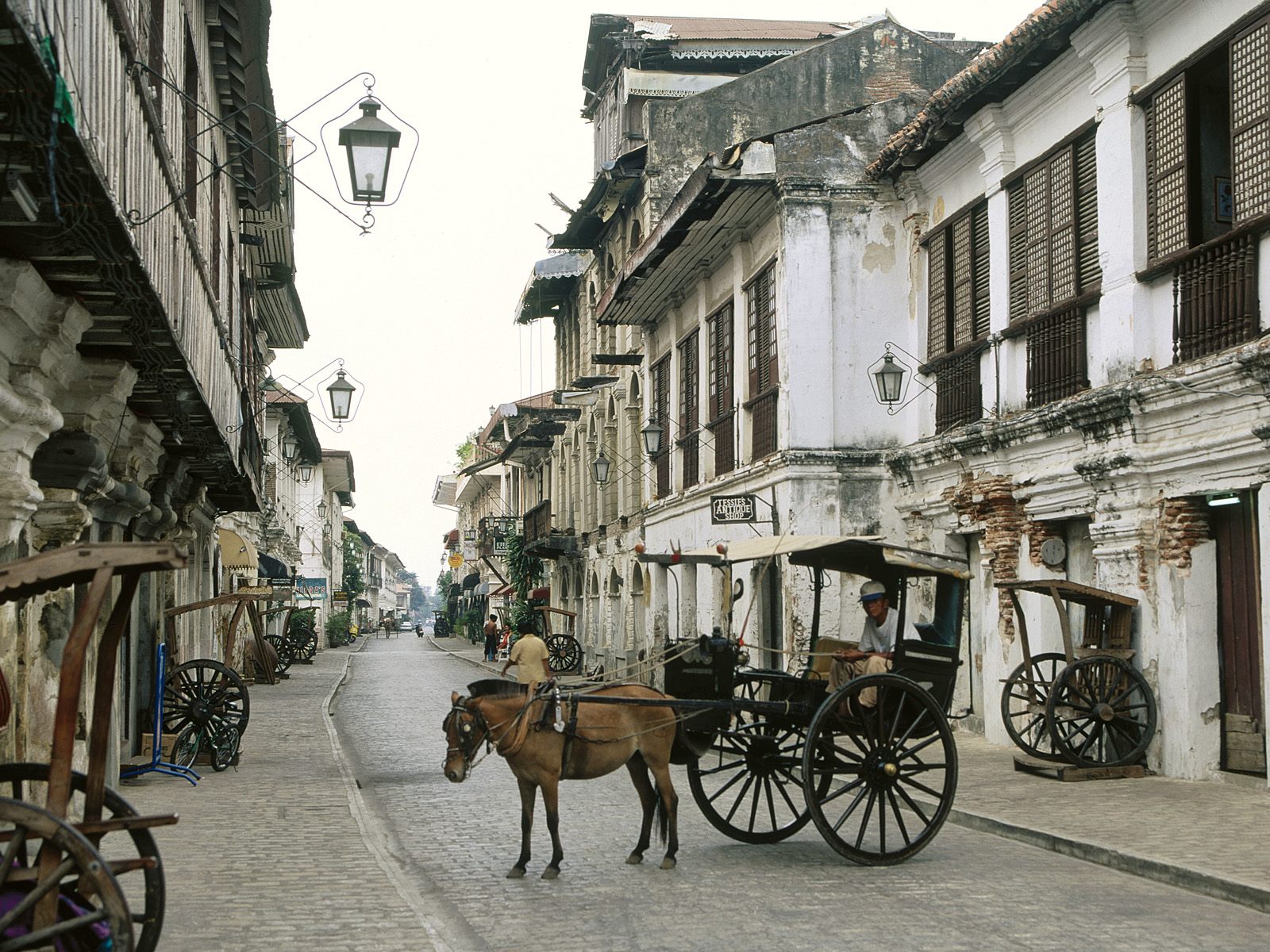
The heart of tourism in Vigan is the Heritage Park, a large tract of land comprising rows upon rows of so-called "ancestral houses" neatly divided by cobblestone streets. Visitors to the park are fully immersed in the old epoch--that is, if anyone could easily understand how a backpacker traipsing along the Great Wall would almost be able to relive the tension of Mongol hordes invading the Chinese mainland, it would be as easy to see how a casual walk through the Heritage Park evokes the same austere pulse of life anybody would have experienced had he or she existed 200 years ago.  

The Heritage Park area has enough bustling shops, commercial kiosks, and tourist activity lining the streets to make for an almost festive ambience, yes, but the patrician architecture of the houses tends to impose a certain somnolence upon the mind and the senses.  An unmistakeable stoic nobility permeates everything here.   It is said that the houses in the Park were a big part of what distinguished Vigan as a prominent city during the Spanish occupation.      

Photo Taken From:

They were by no means the run-of-the-mill dwellings of the ordinary Pinoy--on the contrary, they were the strongholds of the rich and powerful, those at the crest of society.  And they were designed and built inside and out to magnificently portray this majesty.  It can be argued that while the present day state of California in the US has its Beverly Hills, the province of Ilocos Sur had its own array of expensive homes in Vigan City during the height of  the Empre of Spain.  The equivalent of Ferraris crisscrossing wide and paved streets leading to ostentanious garages would back then have been resplendent horse-drawn carriages clattering on cobblestone surfaces sweeping into puertita's ( or "main door"--large enough to accommodate the carriages ) and caballoreza's ( a sort of horse stable ).  

Photo Taken From:

The passage of time has seen these ancestral houses having lost a considerable degree of the lustre and prestige they may perhaps have once enjoyed. Still, it wouldn't be hard to picture any pathetic roughneck Pinoy during those times straying into those streets and feeling the full weight of bourgeoisie antipathy beating his sensibilities down to submission.

Each society would have its enduring monuments to the high and mighty segment of its population, from the old eras to the present.  The Great Wall of China can be cited once again as a popular example.  
                  
Photo Taken From:

It cannot be denied that the Great Wall was conceived out of pure genius.  Its seemingly intractable permanence, its overwhelming sweep and grandiosity cannot but greatly impress anyone who cares to visit.  However, the significance of the Great Wall lies not just in the pomposity of its physical beauty and dimensions.  Equally as important and as permanent is the memory of the millions of slaveworkers who suffered in almost unfathomable torment during its construction.  Simply put, the Wall is as much a testament to an ancient Empire's resounding achievements as well as its society's outrageous forms of depravity.

In the same way, the historic ancestral houses of Vigan may be viewed, in one perspective, as a gloriously successful attempt to transplant the Spanish imperial-era aesthetic in architecture from Europe--all the way across the Pacific into Philippine soil.  That in itself makes worthwhile all the effort invested into the continuing nurture and upkeep of the Heritage Park's historical treasures.  Indeed, even the United Nations has already recognized Vigan City as a World Heritage Site, a distinction which serves to greatly bolster the point.


And yet...there equally is great merit in pointing out that the Heritage Park's lasting legacy should not simply end with mere visual appreciation or the obligatory video or photo opportunities.  Just like the Great Wall of China, whatever beauty can be seen is only one perspective, and ought not blight out numerous other, less appealing memories--no matter how decidedly reprehensible they might turn out to be.

Because if the Great Wall of China has many deplorable aspects to its history, the Heritage Park, too, would reflect its own share of sad stories from its own past. 

The rule of the Spanish is bar none the worst period in Philippine history, even when taking into account the atrocities inflicted by the Japanese during World War II.  For nearly 3 centuries, or a span of about 8 generations, the Spanish authorities instituted so tight a stranglehold of repression among nearly every Pinoy alive that a whole nation of millions became maltreated slaves.  

Photo Taken From:

This doesn't necessarily come as any great surprise, since the Spaniards' policy of brutal subjugation had been enforced over all of their colonies, whether in Asia or in the Americas.  Whole races and populations were thus mercilessly and systematically reduced to impoverished servilitude, an existence defined by lack of proper education, the absence of any form of empowerment, widespread dehumanization, and perhaps most damning of all--the malicious and deliberate curruption of otherwise functional civilizations into underpriviligeded masses.  Widespread hunger, forced labor, unjust taxation, government-sanctioned acquisition of personal property--all of these violations to human dignity were performed relentlessly and on a day-to-day basis.  And they are just the tip of the iceberg.

The Heritage Park once was the enclave of the minute few among the populace who enjoyed immunity from the harsh conditions of the majority around them.  It was the haven of the nobility which arose out of the nefarious practices designed by the Spanish colonizers that sought to siphon monetary gain into the hands of their small band of cohorts.  Every homeowner here had to kowtow to all the policies of the ruling colonizers and heartily enforce the very mechanisms through which even more native Pinoys could be roped in and harnessed like any domesticated work animal.  

Inside their homes, the occupants could wallow in their own self-enriching pursuits and caprices, parlor games and ballroom soirees, all the while perfectly insulated from the hue and cry of squalor and suffering outside.    The sturdy walls, luxurious windows, palatial courtyards, and immaculately manicured lawns all served to segregate the elite ruling class from the lowly servant.  While countless Pinoys starved and toiled and sweated, the ruling class in their small numbers could retreat into their cozy parlors and wake up in the mornings well-rested and well-fed, the only concern uppermost in their minds that of making their own house better-looking than their next-door neighbor's.
Photo Taken From:

Today, it has been over 100 years since the Spanish Empire fell in disgrace.  The Philippines has managed to become its own sovereign nation after overcoming numerous obstacles, including its own internal strife and wars with other countries. And what were once the stately dwelling-places of the powerful in Vigan are now tourist attractions. 

Should it be considered that the ancestral houses of the Heritage Park are simply the mere remnants of an unconscionable era that has long been eradicated with the departure of the colonizers, then contemporary Pinoy society, by all means, should finally heave its collective sigh of relief.  However, the shameful fact is that slavery and oppression continues on unabated until today, long after the derelict physical traces of the Spanish era began eroding.

The province of Ilocos Sur--of which Vigan City is the capital--is one place where the pernicious demarcation line between the powerful few and the powerless majority stays perpetually unmoved.  The harsh realities which the typical Ilocano had to endure under Spanish rule remain unabated until now.  Desperate poverty, lack of education, slave-like labor conditions, improper and unjust administration of law and order, the severe lack of opportunities to lift oneself up from the crushing status quo--these are only some examples which illustrate how the present seems so similar to the past.  

The only people who apparently enjoy lives steeped in riches and power in the province are the so-called "prominent families"--a relatively small group composed of the elite landlord class.  This restrictive circle of families, most of whom inherited their largesse from the fortunes of their ancestors dating back from the Spanish era, own and monopolize just about every controlling interest in agriculture, education, commerce, tourism, and even government services.  Their stature and the very means by which they protect it bears so much resemblance to how the Spanish royalty used to impose their will over "conquered territories" that the differences between the old and new societies might as well be considered negligible.  

Like the time of old, these "prominent families" function as the ruling class of the inveterately underpriviliged population in their jurisdiction.  Like the time of old, the gap between the two social segments--the haves and the have-nots--is so wide that the disparity can be judged not only detestable, it is an outright tragedy of the most calamitous proportions.  

As recently as the time of this writing, statistical reports even bear out the fact that deprivation and poverty pervade the living conditions in Ilocos Sur:

Clip Taken From:

Meanwhile, the ruling class in the province remain secure and insulated within their strongholds, with all their efforts targetted only at sustaining their own high stations, indifferent to the plight of millions at their doorsteps.  It would not be too hard to imagine an analogous scenario where the former occupants of the Heritage Park's ancestral houses would have perhaps been engaged in ballroom dances inside their spacious function halls while slaves put in countless hours constructing the very cobblestone streets which their taskmasters will solely have the benefit to utilize.

It is no wonder then that the underprivileged class sees no respite despite the passage of many generations.


Regrettably, this ongoing polarization of society which puts the greater population into a horrendous disadvantage is not only true in Ilocos Sur, but is also concurrently apparent all throughout the Philippines.  This experience is also mirrored in many other countries which were once under colonial Spain.

Photo Taken From:

There is no mistaking that the attractiveness of Vigan's inheritance of a beautiful district which maps out the past in such visual splendour will entice visitors from all over for years and years to come.  The efforts of to preserve these "Hispanic" ancestral houses can never be praised enough.  The legacy they bequeath can never be underestimated, and the people of Vigan are rightly proud of the Heritage Park--a sentiment which they tend to demonstrate with effusive fervor. 

Much needs to be stated, too, about the ominous irony which can enrich one's experience when coming over as a tourist.  Because while the elements and the ravages of time can eventually threaten priceless houses of the Heritage Park, the spirit behind what these houses stood for has remained sturdier and more resilient.

Truly, there are things better dismantled than preserved.

Monday, March 30, 2009

Sojourn In The North: Two Kids

( In a series of blogs this Commuter will be elaborating on the impressions left by his experiences in exploring some select areas of the Ilocos Region, impressions which he hopes will provoke constructive thought among all readers. What follows is the first of these blogs. )

It took quite a long while before this commuter was able to travel again; but never in my wildest dreams had I imagined the circumstances under which I would be afforded the chance this time around.

Having worked in the film and broadcast industry for the better part of 12 or so years, this commuter was deemed qualified enough to give lectures to a small group of professionals operating a local television channel in Vigan, Ilocos Sur, for the purpose of improving their technical knowledge. When the invitation was sent to me, I was informed that the local Vigan channel had already been operating for better part of three years, and yet the channel's founder was apparently not satisfied with what his employees were doing so far. He wanted his crew to produce output that could hopefully rival the work of major broadcast companies in Metro Manila. It thus fell incumbent upon me and a fellow colleague to do our part, however small, to whip them up to a more formidable set of broadcasters.

This commuter is no stranger to conducting lectures and seminars to for the broadcasting community, but this invitation was a bit off-tangent compared to the usual. The trip alone meant that I had to travel for around 7 to 8 hours by bus from Metro Manila to Vigan, traversing a path that practically spanned almost half the length of the largest island of the Philippine archipelago--the farthest point up north I would have to reach by land-based transport my whole life. Too, I would be staying at Vigan for around 7 or 10 nights straight according to the estimates of me and my colleague's hosts...something not usually required for even veteran workshop panelists of my ilk.

The whole activity sounded too tedious and burdensome at first glance. And yet, I was assured that my "7 to 10 days" would not be a rigid and formal affair, but would instead be more likely a hearty getaway vacation sprinkled here and there with a few moments when I would have to impart some tips, techniques, or tidbits of knowledge in a manner which would remain relaxed and laid back. I imagined lecture sessions that resembled tete-a-tete's under the canopies of a noveau-Venetian-style coffee shop. 

After having been reassured of the conduct of the trip, I eagerly agreed.  Who was I, after all, to refuse? It was going to be a welcome hiatus from Metro Manila, it was to be a refreshingly long road trip through miles of tropical hinterland, and at the end of it all was the possibility of an invigorating 10-day junket. And so on the night of March 18, 2009, I was bundled up in a bus embarking on my furthest ever sojourn to the north, in the company of fellow Pinoys seeking their own respective diversions.

Which, it turned out, didn't disappoint me, after all.

Map taken from

Vigan is a city that straddles a small portion of the northwestern coast of Ilocos Sur province. The city has long been known as a tourist spot, where visitors can marvel at preserved Spanish-era dwellings covering a huge tract of land. This cluster of houses has been conferred by the United Nations with the prestigious title of an international heritage site, and so the name given to it by the government is, aptly enough, the Heritage Park.


Photo courtesy of

This commuter's stay at Vigan proved to be a junket in every way--the room I was billeted in was just above the main offices and production facilities of the television station itself, and the accommodations were far from spartan as it was fairly spacious, and came complete with airconditioning, hot shower, cable tv--and even wi-fi access to boot. Food was also generously provided all day. I had it better than most of the visitors who pay top dollar just to visit Vigan...and I wasn't even strictly a tourist.

Of course I had to fulfill my end of the bargain, and so at certain intervals I had to gather up the television crew and proceed with the workshop sessions they expected of me. However, I have to qualify that these sessions were fairly short and not as comprehensive as the training I would normally provide. What's more, the organizers of the workshop appeared to be more eager to tour me around rather than "waste" unnecessarily longer hours listening to my lessons. It seemed atypical that business could be mixed with such an inordinate volume of pleasure in this way, so to speak, but this was not for me to debate. And so during most of the time I stayed in Vigan, this commuter and my hosts were assiduously hopping from one visitor-friendly place to another as easily as if we were playing hopscotch, and were finding time to coach the television crew in between our forays. Looking back on it now, I sure do hope that the Vigan broadcasters learned a lot from me, because I sure did learn a lot about their hometown. It would certainly be discomfitting to think that I took more than I gave.

Suffice to say that this first Vigan trip holds plenty of memories for me, most of which I will expand upon at a later opportunity. However, for the present, this commuter would like to dwell on some particular events that transpired near the last days of my stay in the Ilocos region...and two local inhabitants who have never left my mind long after I left for home.

My journeys often end with a climactic punchline, and so even though it was a surprise that my hosts offered me a chance to visit the famed Pagudpud beaches still further north of Vigan--seemingly out of the blue--the prospect became simply just another one of those fitting conclusions which Fate or Life bestows on any one of my commutes.

My hosts were operating a fully-functional television station in Vigan, and even though the operations were lilliputian compared to the networks I previously worked for back in Metro Manila, the Vigan television crew were no less serious in expanding their reach throughout the Ilocos province. And so they decided to send a small contingent to Pagudpud with the purpose of filming two beach resorts for a travelogue special on their channel. All the other television networks have their own travel specials, and so why not them, too? The television crew would be filming for a total of three days and two nights, and the emphasis of the filming would be on what luxuries and amenities the two aforementioned beach resorts were capable of offering to both local and foreign tourists. Sure, there was work involved, but for a visitor like me, it promised to be another junket--business mixed with pleasure...a lot of it.

On the afternoon of March 26, a camera crew piled into a van complete with all the necessary equipment--and this commuter was along for the ride. Everyone among us knew that Pagudpud had been recently receiving buzz over the internet as the newest world-class beach resort town "discovery" in the Philippines, and we were very eager to film whatever attractions the town and its beaches were so proud to offer its visitors. Once the whole crew was assembled at the rendezvous, we cranked up the van's engine and cruised out of Vigan with eyes twinkling at all the prospects of hitting the beach.

Map taken from

Vigan might be far from Metro Manila, but Pagudpud seemed just as far from Vigan. We started out from Ilocos Sur, but had to cross over to Ilocos Norte, and then had to end up on its northernmost tip ( Sur means South while Norte means North--two provinces with the same first name ). Along the way, I caught even more glimpses of long stretches of green flatlands and plantations outside the windshields, punctuated here and there by settlements and farmhands baking under the simmering tropical temperatures. Every now and then my hosts would point out some significant landmarks for the novice traveller to Ilocos, such as the occasional historic church, a particularly ancient lighthouse, as well as the more modern fixture in Ilocos Norte--the wind-powered electrical supply facility operated by Europeans in front of a sweep of coastline facing the South China Sea.


Photo taken from

Soon, green farmlands gave way to lofty mountains and cliffsides facing yet another vista of azure sky and blue sea, the glitter of water seamlessly blending with the horizon to evoke a vision of clear infinity.  We were finally in the town of Pagudpud.


Photo Taken From

The long and winding road that cruised under the proud archway designating the town took us past small pockets of settlement,  business establishments, as well as the Town Hall.  We had to soak up a few more kilometers past them all to arrive at the beaches.  The sea might have again taken cover behind the mountainsides, but even the drone of the van's engine could not hide the anticipation felt by the whole crew.  And then, almost unexpectedly, we turned off the main highway onto a dirt path, felt our vehicle laboriously negotiate the grit and gravel under its wheels for a few more meters, and then the ocean peeked out once more beyond a small hilly rise.  Once we descended the rise, the scent of brine and saltwater could no better prepare us than a roll of drums, trumpets, and the parting of curtains for our grandest glimpse of paradise.   


Photo Taken From

It is often said that the best Philippine beaches are found in Boracay, Puerto Galera, Bohol, and the Palawan Islands.  One look at Pagudpud's white-sand coastline and inviting waters, relatively not as well known as those thus far mentioned, gives credence to the idea that no one should close the book on other beaches which may be out there.  And the Vigan crew was out to prove that, for Pagudpud at least, all the hype surrounding it was well-deserved.  

There were simply a dearth of experiences in the Pagudpud beach resorts to enjoy...and to film, in our case, of course.  The mostly temperate climate of the Ilocos region allowed for plenty of opportunities for daytime or nighttime scuba diving, kayaking, recreational boat-riding, snorkelling, even occasional surfboarding ( when the tides act appropriately ).  Not to forget, by the way, swimming in the ornate clear-blue waters, acquiring those provocative suntans, indulging in the ever enjoyable game of beach volleyball, and snapping up digicam pictures of every fancy.  This commuter chilled out with a few bottles of beer while watching the sun go down, an experience which was particularly divine.  Along the Pagudpud coastline, everyone is smiling, from the fish vendors hawking fresh catch, to the kids playing in the sand, to the resort-hogging tourists and backpackers.  It was a grand time, even for the Vigan television crew towing their cameras, savoring all of what they documented.


Photo Taken From:
   
Photo Taken From:

It was an expedition into pure revelry for this commuter, having been treated to such an endearing amount of hospitality from my hosts, starting with an unforgettable stay in Vigan all the way through to three days and two nights in enchanting Pagudpud.  During most of that time,  one experience to the next lifted me up from one frontier of delight to yet another one higher,  until the days and nights seemed immersed in a misty and cloudy neverland of stratospheric adventure...

Until my encounter with two kids in Pagudpud brought me back down to earth.  At least.

I will never be able to furnish pictures of those two kids, but they remain ferociously persistent in my memory.  They will perhaps be no less indelible than the recollection of a deeper layer of bread under the icing of the cake of anyone's typical first birthday.  It stays as a reminder that underneath all the frivolous and festive pictures lie truths which we can never deny as being part of our everyday reality, too.

The first of these two kids was actually a member of the Vigan television crew.  She was a bright-eyed, olive-skinned Ilocano native of sixteen, brought along as a "stand-up model" for the Pagudpud filming.  Her role was akin to that of those attractive girls utilized as props when photographing sports cars--a sort of attention-getting foreground in relation to the scenic background, with the intention of accentuating the beach scenes with the presence of a shapely female in beach attire.  Everybody in the television crew was provided free meals by the resorts they filmed, which was a standard practice in such transactions.  I noticed, however, that our stand-up model was consuming more than the usual proportion of the food, something which might be judged almost glutinous, although certainly not glutinous to a profane degree.  It was simply that this commuter adjudged the model to consume a bit more than the usual share. 

I was insensitive enough as to tease her about it during our customary meals.

Later on I realized how much of an insouciant buffoon I had acted.  Upon chatting in more friendly terms with our "standup model", I learned that she wasn't exactly as well-to-do as any typical "model"( most of which, in the circles where I worked at least, came from upper-tier society).  She in fact came home everyday to a family who could barely make ends meet. Her father had abandoned her family and her mother was working as a domestic helper ( or, more tritely, a maid ) in Singapore.  In her household she had to live with five other siblings, as well as a slew of other relatives relying on a measly stipend from her mother in Singapore. Which meant that food was scarce almost all the time.  In short, hers was a fundamentally hungry family, perhaps always making do with whatever small amounts of food could be funnelled to each member by ratio.  Far from my own experience.  

As a regular worker in the media industry, I would hardly be characterized as a person lacking good nutrition at home.  I certainly did not crave for gourmet food as much as, well, people with less means do.  It takes a certain magnanimous insight to realize that as a more fortunate Pinoy, I would be in some respects very distant from millions of other Pinoys--and yes, including most of the native Ilocanos--who would be incapable of enjoying the same latitude in choosing their preferred food at home.  No, that luxury is more often associated with people who can afford to live in Metro Manila, like me.  

For most of those living in Ilocos, being able to eat the food of your own personal, and perhaps, luxurious taste, would occur only once in a while.  Such as in a junket where you find yourself lucky enough to be involved in, perhaps exactly like the case with our standup model and this particular trip to Pagudpud.   Those who cannot eat the proper food everyday at home, after all, would take advantage of any free and unencumbered opportunity to do so with gusto.  And so I thus had to reprimand myself severely for imposing my own disproportionate criticism, however lightly intended as parody, upon another member of our party.  


Photo Taken From:

During another lazy afternoon in the middle of filming, after I had just emerged from the beachwaters and flopped down like a tired amphibian on the golden sand--intending to enjoy a little time alone to myself under the breeze, which I reckoned would dry me off in a short while--a diminutive boy of about 12 or 13 years old approached and tried to sell me some souvenir merchandise he held in two baskets.  The first basket contained corals shaped into cigarette ashtrays with tiny pennants having the word "Pagudpud Beach" emblazoned on them.  The other basket held a bounty of assorted beads fashioned into wrist bracelets, necklaces, anklets, just about anything typically worn by any fashionable beach junkie.

    
Phot Taken From:
      
On any stretch of resort beach, there would always be found these children among many others peddling their wares to tourists.  This particular kid caught my eye because he held a third item aside from his two baskets--a notebook folded open to show kiddie drawings and scribblings.  I wasn't particularly interested to buy anything to take home with me--I absolutely find no appeal in taking anything back home from any of my commutes except pictures--but I found it extremely interesting to find out what kind of drawings this kid made.  I made it clear to the fellow that I wasn't going to buy anything from him, but asked permission from him to browse through his notebook.  

It turned out that the kid was quite proud of his drawings and seemed all-too-willing to show them to anyone who would ask.  He readily sat down beside me and pointed out to me drawings depicting his family, his house, his pets, and a few other landscapes he especially found worthwhile committing to paper.  He also showed me some pages on which he wrote down a few passages which he copied from some books he read or even some street signs he encountered.  I prodded him to tell me more about himself, and the kid smilingly obliged with the confidence of a natural storyteller.  

He told me that he was in the middle of his high school studies when he had to quit school owing to the necessity of having to help his parents earn a living for the whole family.  He had six other brothers and sisters, all of them younger than him, and his mother and father were in too desperate straits that his own efforts were more than welcome if it meant more income for the household.  They lived in a ramshackle house by the beach side, set off from the sandy shore by a row of thick foilage.  Every day, while his younger siblings trooped down to the beach to play under the sun while waiting for food to come by at the table, he would gather up his merchandise from a certain dealer ( which he never did come round to describe in any specific way ) and troll the resorts to find buyers.  Every once in a while he would strike lucky with troops of tourists who patronize his wares by the dozen or so, but these fortunate instances were few and far between, perhaps as distant from each other as the occasional boats stranded on the sand.  His family of eight would normally eat the cheapest canned goods, he told me, still smiling.  They couldn't usually eat three times a day.  I regarded him with a squint under the almost blinding sunlight, and he seemed to be telling the truth, as I gathered from the sticklike proportions of his build.

I asked him if his parents ever reprimanded him if he didn't make any sale for one day.  Continuing in that matter-of-fact tone of his, the kid said yes.  But he wasn't physically punished, he continued.  I asked him if the family had already eaten anything that day, since by then it was already late into the afternoon.  The kid smiled and told me that no, they haven't had anything, and so would I be kind enough to buy some souvenirs so later on he could at least have enough to buy a can of sardines?

Dreadful enough as it was that I refused, another member of the Vigan crew came by and redeemed the situation by purchasing two items from the kid's baskets, without having had heard of the kid's stories.  This commuter does not believe in any kind and benevolent God; however, in short flashes of serendipity like the one that just happened, I do believe that Fate or Life sometimes has the propensity to alleviate burdens for those who have faith in them.  

After my colleague from Vigan was able to furnish this kid his resources for buying his family's possible next meal, we continued chatting.  I directed his attention to a boat of fishermen apparently setting out across the water for a night's work and asked him if he ever considered becoming a fisherman some time, if only to engage in a form of work which could more directly address their need for food.  The kid told me that he would probably try some time in the future, if circumstances didn't permit him to go back to school.  I told him that back where my hometown was, in Bohol province, the residents could at their leisure climb any coconut tree and pick off coconuts to eat if they desperately needed food.  I pointed out to the kid the rows of coconut trees fringing the shore.  The kid told me that he wasn't sure if those coconut trees could be harvested for their fruits since someone probably owned all of them.  I told him that, for tonight at least, he would be able to go home with proceeds from the sale he conducted with my Vigan colleague.  It was certainly better than nothing.  Again, this kid smiled in approval.  It is said that Pinoys generally display an uncanny resilience against the most desperate adversity in life because they can smile so swiftly in the face of crushing realities.  I've seen the same kind of smile from all sorts of poor kids everywhere I travelled in the Philippines.  Still, whenever I catch a glimpse of it, the experience always feels new each time. 

At that particular moment, the kid's smile felt as if it was the most significant delight the beach could offer to this commuter.

 
Photo Taken From:

It is a supreme irony that a commuter like me, visiting Ilocos from some distant town far to the south, could enjoy more of the bounty and abundance found in its local cuisine and famed beaches compared to those two kids I met.  Certainly their stories are not isolated experiences; more likely their circumstances are common to a majority of the Ilocos populace.  Hunger and deprivation in the midst of a locale which could otherwise abundantly provide  all sorts of gastronomic delights; limited opportunities for self-determination in an otherwise vibrant resort town that tourists of every sort might one day scramble helter-skelter to be able to visit--these are ironies which I usually encounter every time.  I had partaken of a junket that for the most part I intended to keep me away from the sobering realities of my Pinoy existence.  These realities will always catch up with my commutes, however, since it takes almost no effort at all for the underlying paradoxes to reveal themselves to even the most casual observer.  

In any case, my junket was about to come to an end, since the Pagudpud visit was my last stop before taking the trip back to Metro Manila.  My encounter with the two kids did not in any way lend a downbeat color to my celebratory mood in Ilocos; on the contrary, it only strengthened my resolve that all of the times I indulged in some, let's say, hedonistic pursuits were just my own way of recharging my energies in order to gather momentum so I can plunge yet again into the more pressing reason for keeping on commuting--to tip the balance from darkness toward the light.  I still believe in Fate and Life, as I always keep telling myself.  Somehow all my efforts will yield fruit.  One day, I resolve to return to Ilocos...hopefully, with resources to somehow contribute towards making everybody I encounter there realize the wealth and abundance that I myself have partaken of in their own home.


Photo Taken From: